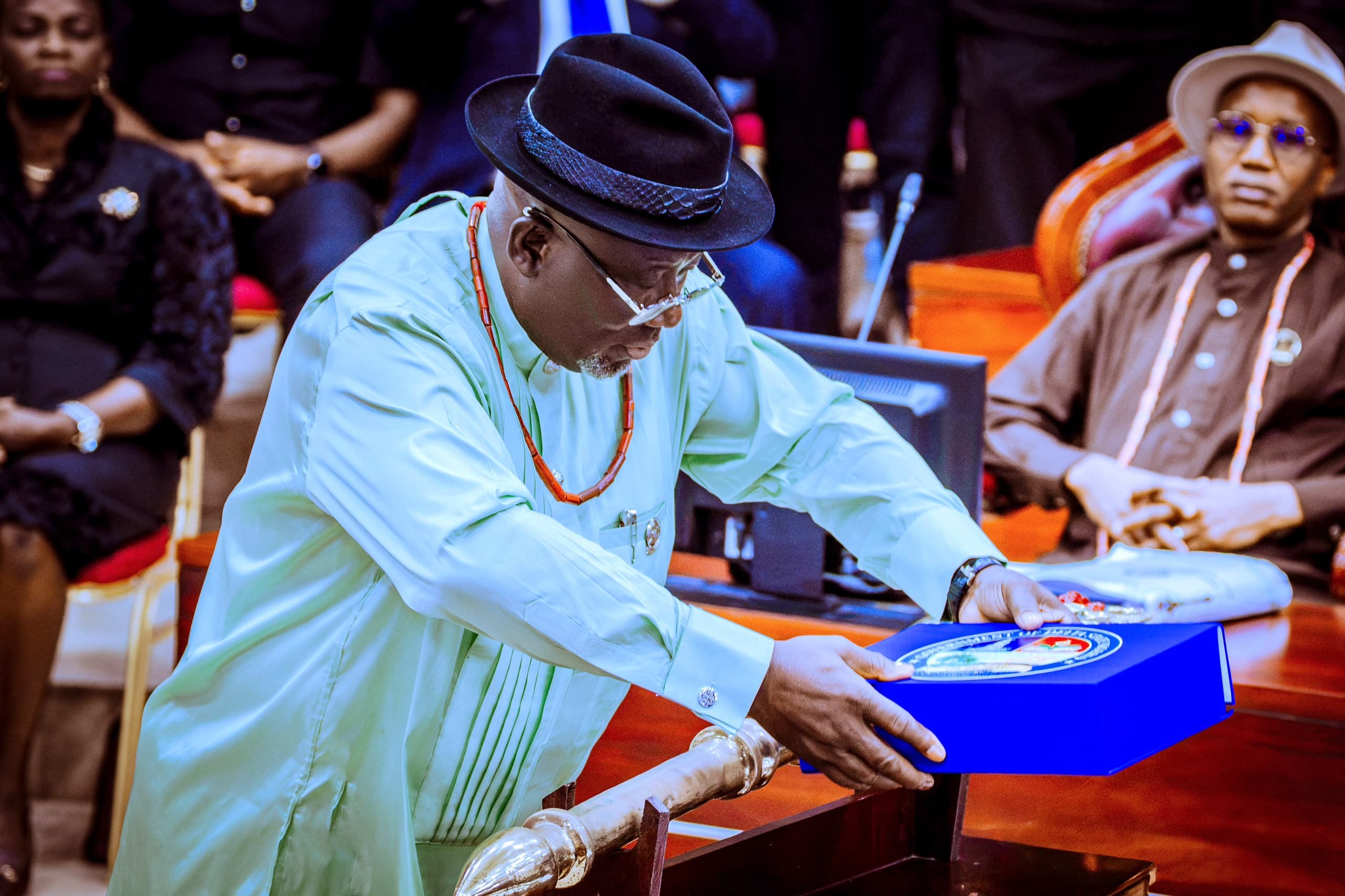
Delta State Governor, Sheriff Oborevwori, on Monday presented a proposed N1.23 trillion budget for the 2027 fiscal year to the State House of Assembly, with 65 per cent allocated to capital projects. Christened Budget Of Sustained Prosperity and Enhanced Growth, the proposal provides N806.8 billion for capital expenditure and N430 billion for recurrent spending.
Presenting the estimates to lawmakers in Asaba, Oborevwori said the budget was designed to consolidate ongoing projects, stimulate economic growth and improve residents’ living conditions. He explained that the proposal was N493.01 billion, representing a 28.5 per cent reduction from the N1.729 trillion approved for 2026, adding that the reduction reflected his administration’s commitment to realistic spending projections and fiscal discipline.
The governor identified the completion of ongoing projects, initiation of new investments, consolidation of achievements and expansion of social interventions as key priorities.
On infrastructure, he disclosed that his administration had embarked on 872 road projects and 20 bridges and flyovers since assuming office, covering 2,348 kilometres of roads and 1,871 kilometres of drainage infrastructure across the state. He added that community consultations identified roads, bridges and jetties as major priorities, particularly in rural and riverine communities.
Consequently, N320 billion was proposed for the two Ministries of Works to sustain infrastructure development and complete ongoing projects. On revenue generation, Oborevwori said the state’s Internally Generated Revenue (IGR) had grown from N83 billion in 2023 to a projected N283 billion by December 2026, attributing the improvement to technology-driven collection, an expanded revenue base and efforts to eliminate revenue leakages without imposing additional tax burdens.
The governor also disclosed that his administration had repaid N400 billion out of the N463 billion legacy debt inherited, leaving an outstanding balance of N63 billion. He expressed confidence that the remaining debt would be cleared by the end of the first quarter of 2027.
In the education sector, the proposed budget allocates N74 billion, comprising N10 billion for primary education, N12 billion for technical education, N12 billion for secondary education and N40 billion for higher education. Oborevwori said the government would sustain investments in school rehabilitation, teacher development, digital learning, laboratories and accreditation of academic programmes.
He further disclosed that N10.8 billion had been approved for the rehabilitation and renovation of primary and secondary schools.
For healthcare, N50 billion was proposed to support hospital upgrades, medical supplies, recruitment and improved welfare of health personnel. The governor also highlighted the College of Health Technology, Ovrode, which has enrolled more than 800 pioneer students, as part of efforts to address manpower shortages in the health sector.
Other allocations include N50 billion for the 25 local government areas, N20 billion for the Delta State Capital Territory Development Agency and N20 billion for the Warri-Uvwie and Environs Development Agency. The budget also provides N12 billion for energy, N10 billion for urban and physical planning, N5 billion for agriculture and N5 billion for social interventions.
On economic diversification, Oborevwori said his administration was attracting private investments into agriculture, industrialisation, entertainment and small and medium-scale enterprises. He cited the $70 million Olam Agri feed mill project at Ogwashi-Uku as one of the outcomes of the 2026 Delta State Economic and Investment Summit, noting that the project would create employment opportunities and provide a ready market for locally produced agricultural commodities.
The governor further disclosed that Delta State’s Gross Domestic Product (GDP) rose from N14.5 trillion in 2024 to approximately N17.9 trillion in 2025, making it Nigeria’s fifth-largest state economy. On electricity, he said his administration had executed 2,155 energy projects, including 90 transformers, 2,003 solar street-lighting projects and 23 power-grid extensions.
Oborevwori also disclosed that he had assented to the 13th-month salary bill for public servants, with implementation commencing in December 2026. He said the initiative was introduced in recognition of workers’ contributions and to ease their financial responsibilities during the festive season.
On security, the governor said his administration was strengthening collaboration with security agencies to tackle kidnapping, cultism, pipeline vandalism and other criminal activities. He disclosed that approval had been given for the construction of 25 police divisional headquarters for state police, alongside an application to recruit 1,000 forest guards.
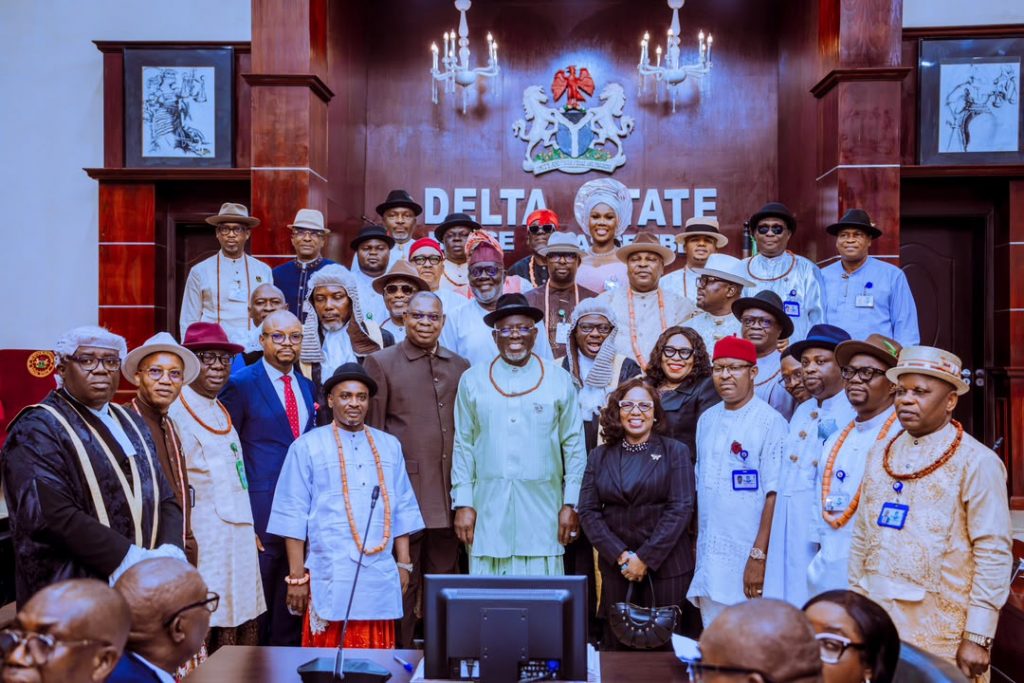
Oborevwori assured that the 2027 budget would prioritise infrastructure, economic diversification, human capital development, peace and security, while ensuring that ordinary Deltans benefited from the state’s economic growth. He subsequently presented the Appropriation Bill to the lawmakers for consideration and approval, following a motion moved by the House Leader, Emeka Nwaobi, and seconded by Marilyn Okowa-Daramola.
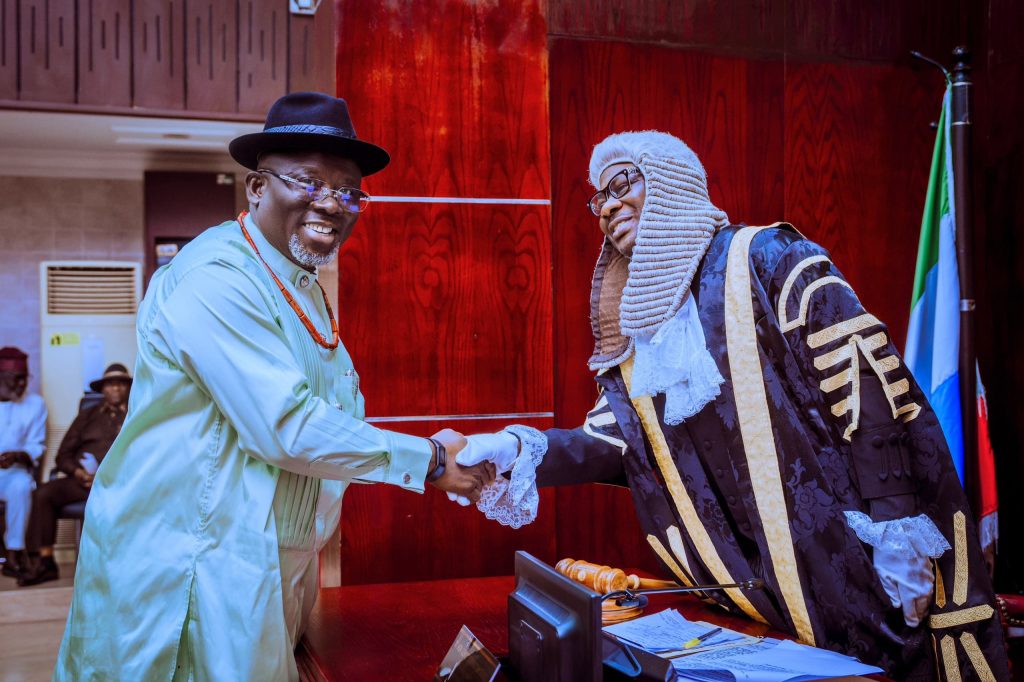
Earlier, the Speaker of the House, Emomotimi Guwor, commended Oborevwori for his administration’s achievements in infrastructure, healthcare, education, social welfare and human capital development. He particularly praised the approval of the 13th-month salary for public servants, describing it as evidence of the governor’s concern for workers’ welfare.
Guwor reaffirmed the legislature’s commitment to maintaining a cordial working relationship with the executive arm of government, disclosing that the House would take the bill for second reading on Tuesday, November 17, 2026. He noted that cooperation between both arms of government had contributed to Delta State’s development and assured the governor of the Assembly’s support for the proposed budget.