By Akpodhoma Michael Ajirioghene
In every local government, there comes a defining moment when residents begin to ask a simple but fundamental question: has governance made any meaningful difference to their daily lives? In Isoko South Local Government Area of Delta State, that conversation is increasingly shifting from expectations to visible results.
Two years after Hon. (Comr.) Warri Ovoke Friday assumed office as Chairman on July 15, 2024, the council is gradually carving out a new identity—one defined by renewed infrastructure, stronger public institutions, improved social services and a leadership approach that places community needs at the centre of governance.
When he assumed office, the challenges were unmistakable. Critical roads had deteriorated, public facilities required urgent intervention, schools and healthcare centres needed support, while several communities grappled with infrastructure deficits and recurring security concerns. Rather than spreading the council’s limited resources too thinly, the administration adopted a deliberate strategy: tackle the most pressing needs first while laying a solid foundation for sustainable development.
That approach has since translated into tangible results across virtually every sector of the local government. Perhaps nowhere is the impact more visible than in infrastructure. Across Isoko South, road rehabilitation projects have restored access to communities that had endured years of neglect. Failed portions of the Oyede-Irri Road have been rehabilitated, while emergency interventions along the
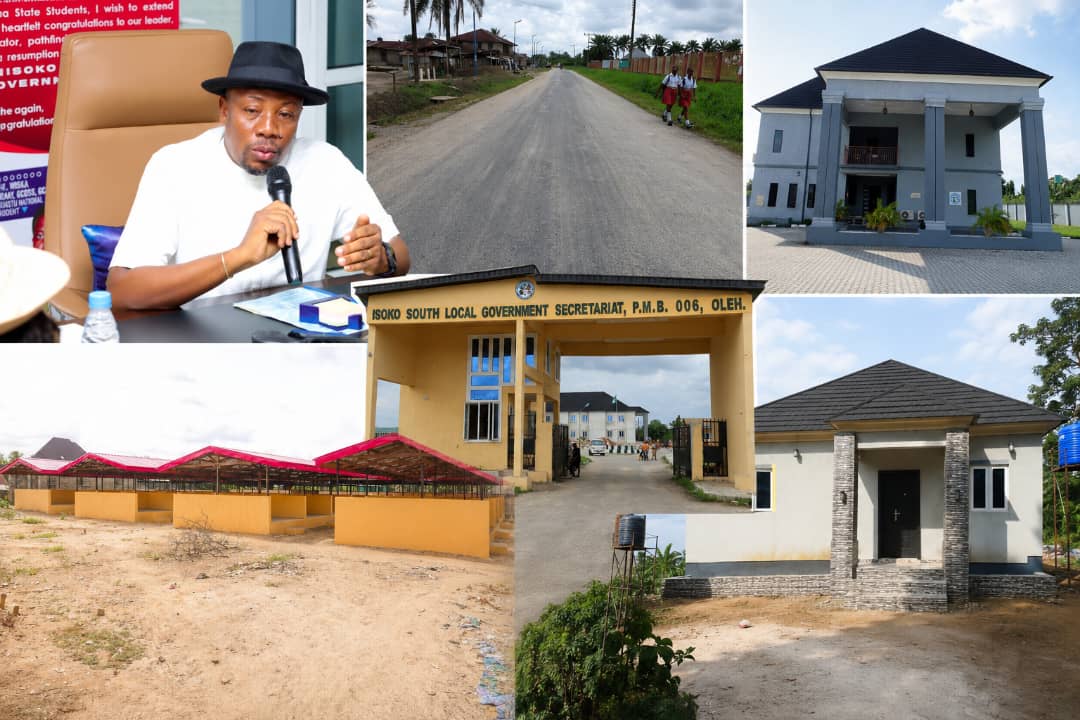
Oleh–Emede–Olomoro–Otor-Iyede corridor and the Idheze-Irri back road have eased movement for commuters, farmers and traders alike. The construction of a new culvert on Ogbemudia Road in Oleh has further improved connectivity and reduced the hardship previously experienced by motorists and residents. The administration has also prioritised the rehabilitation of public assets. The council secretariat has been transformed with the construction of an ultra-modern gatehouse and improved security infrastructure, while the official residences of key officers including the Chairman, the Head of Personnel Management and the Secretary to the Local Government have been renovated to enhance administrative efficiency.
Solar powered electricity installations at both the Chairman’s official residence and the council secretariat further demonstrate the administration’s commitment to sustainable governance.
Commercial activities have also received fresh momentum. The rehabilitation of Olomoro Market and Idheze-Irri Market, complete with modern stalls and lock-up shops, has provided traders with safer and more conducive business environments, reinforcing the council’s commitment to strengthening the grassroots economy.
Yet, the administration appears more focused on the future than celebrating completed projects. Construction is ongoing on a modern administrative secretariat expected to redefine public service delivery within the council. Similar progress is being recorded at Enwhe Comprehensive Grammar School, where an administrative and staff block is under construction. A modern police station is also being built in Enwhe to strengthen the area’s security architecture. Across public primary schools, classroom furniture is being distributed to provide pupils with a more conducive learning environment.
Education remains one of the strongest pillars of the administration. More than 18,000 exercise books have been distributed to pupils in government-owned primary schools, easing the financial burden on parents while encouraging effective learning. Teacher verification exercises and regular school inspections have equally reinforced accountability and improved educational standards across the local government.
Healthcare has received equal attention. During the cholera outbreak in Ikpide-Irri, the council’s prompt intervention helped contain the public health emergency. Through its partnership with the Omodu Foundation, residents have benefited from free medical outreach programmes, while primary healthcare centres have received medical equipment to improve service delivery.
Public enlightenment campaigns conducted in collaboration with the World Health Organization have further strengthened awareness of HIV/AIDS and other communicable diseases. For an agrarian local government like Isoko South, agriculture remains central to economic survival. Recognising this reality, the administration distributed improved cassava stems across the eleven wards and established demonstration farms for pepper, potatoes and watermelon cultivation. These initiatives are designed not only to improve food production but also to encourage the adoption of modern farming techniques among local farmers.
Economic empowerment has equally featured prominently in the administration’s agenda. Financial grants totalling ₦11 million have been disbursed to small-scale entrepreneurs, enabling beneficiaries to expand their businesses and strengthen household incomes at a time when many families continue to grapple with economic challenges. Good governance extends beyond physical projects; it is equally measured by peace, stability and social cohesion. In this regard, the Warri Ovoke administration has recorded notable interventions.
From resolving the leadership crisis in Idheze-Irri to facilitating peace initiatives in Olomoro and responding swiftly to security concerns in Emede and neighbouring communities, the council has consistently partnered with traditional rulers, community leaders and security agencies to preserve harmony while protecting lives and property.
Environmental sanitation has also remained a recurring priority. Routine sanitation exercises across Oleh, Irri, Emede and other communities have helped sustain cleaner surroundings, while annual Children’s Day celebrations continue to promote social inclusion and create memorable experiences for young people across the local government. Administrative efficiency has not been overlooked. The procurement of official vehicles for both the Vice Chairman and the Leader of the Legislative Arm has strengthened institutional capacity and enhanced service delivery.
What distinguishes the administration, however, is not merely the number of projects executed but its deliberate effort to restore public confidence in grassroots governance. At a level of government often criticised for underperformance, Isoko South is gradually presenting an alternative narrative—one in which local government serves as a genuine catalyst for development rather than merely the closest tier of government.
Certainly, challenges remain, as they do in every developing society. Several flagship projects are still under construction, while public expectations continue to rise. Yet, the trajectory of the past two years reflects a leadership committed to building enduring institutions rather than simply administering the affairs of government. As Hon. (Comr.) Warri Ovoke Friday marks two years in office, the final verdict may ultimately belong to history.
For many residents of Isoko South, however, the evidence of purposeful governance is already visible in rehabilitated roads, improved schools, better-equipped healthcare facilities, empowered entrepreneurs, safer communities and renewed hope that grassroots government can indeed serve as the engine of meaningful development.
If the first two years have been about laying a solid foundation, the years ahead will determine how enduring that legacy becomes. For now, however, Isoko South appears to be steadily writing a new chapter one in which governance is increasingly measured not by promises made but by lives positively impacted.